
Food packaging is filled with language designed to signal safety and quality. Terms like clean label and organic are often used interchangeably, but they do not mean the same thing. The difference matters because one is regulated by law and the other is largely a marketing concept.
This article explains what clean label and organic actually mean, how they differ, and where consumers are most often misled.
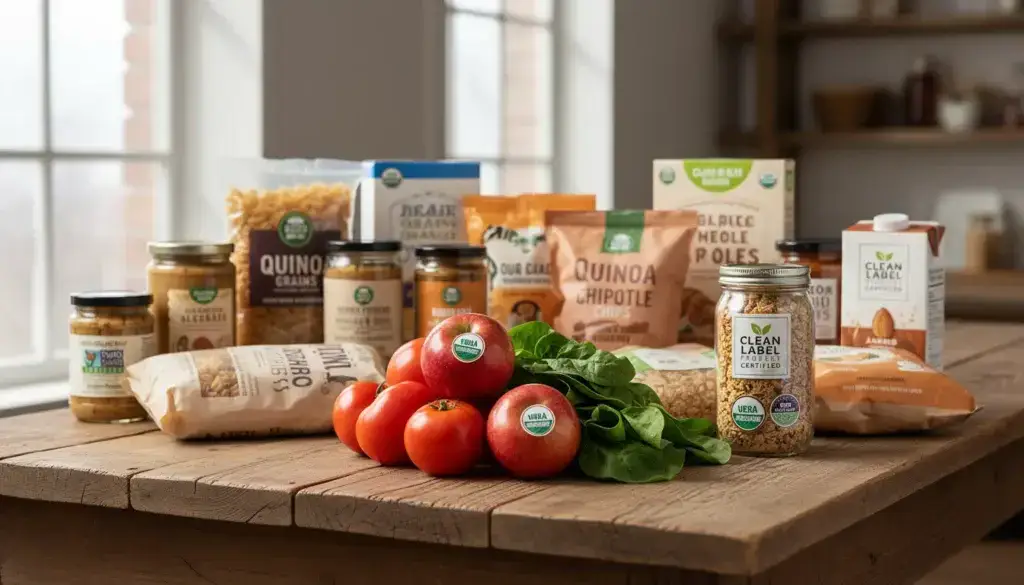
What Organic Really Means
In the United States, organic is a legally defined term. Products labeled USDA Organic must comply with federal standards that govern how food is grown and produced.
Organic requirements include restrictions on synthetic pesticides and fertilizers, a prohibition on genetically modified organisms, limits on antibiotics and growth hormones in animal products, and rules around organic feed and farming practices.
Organic certification focuses on production inputs and agricultural methods. It does not guarantee that a product is free from all contaminants or that it is minimally processed.
In simple terms, organic regulates how food is produced, not absolute purity.
If you are new to Compliant Defiant, the Start Here page explains the purpose of this project and how these articles fit together.
What Clean Label Really Means
Clean label has no legal definition in the United States. There is no certification body, no federal standard, and no enforcement mechanism.
The term is typically used to suggest shorter ingredient lists, fewer artificial additives, and ingredients that consumers recognize. These criteria are subjective and vary widely by brand.
Because clean label is undefined, companies have broad flexibility in how the term is applied. What one manufacturer considers clean, another may not.
Clean label describes perception rather than regulation.
Why Consumers Confuse Clean Label and Organic
Many consumers assume that clean label means safer or that organic means cleaner. Sometimes those assumptions overlap, but often they do not.
A product can be organic and heavily processed. A product can be marketed as clean label without meeting organic standards. Some products are both, and many are neither.
The label alone does not provide enough information to determine overall quality or safety.
Why Independent Testing Matters
Because labels focus on different aspects of food production, they do not always reflect what is present in the final product.
Independent testing organizations such as the Clean Label Project evaluate products for contaminants that are rarely disclosed on packaging. These include heavy metals, pesticide residues, plasticizers, and industrial byproducts.
Testing results have shown that products marketed as clean label do not consistently test lower for contaminants. In some cases, organic products perform better. In other cases, they do not.
The key point is not that one label is good and the other is bad. The point is that marketing language does not always align with measurable outcomes.
What Organic Does Not Guarantee
Organic certification does not guarantee the absence of heavy metals. Soil conditions, water sources, and environmental exposure all play a role in contamination levels.
Organic standards also allow certain naturally derived pesticides and processing aids. While these are regulated, they are not impact free.
Clean label claims do not address these limitations. They re-frame ingredient acceptability without addressing contamination or processing risks.
Neither label alone guarantees safety.
The Practical Difference Between Clean Label and Organic
Organic is a regulated standard that governs how food is produced. Clean label is an unregulated term that governs how food is marketed.
Organic focuses on inputs and farming practices. Clean label focuses on consumer perception.
Both can be useful signals. Neither should be treated as proof.
How to Read Labels More Critically
Rather than asking whether a product is clean label or organic, better questions include what the label actually regulates, what it ignores, and whether there is evidence beyond the packaging language.
Clear thinking begins when reassurance ends.
Final Takeaway
Clean label exists because consumers want simplicity and transparency. Organic exists because certain agricultural practices required legal boundaries. Neither label is inherently deceptive, but both are incomplete.
Understanding the limits of labels is the first step toward making better decisions.