
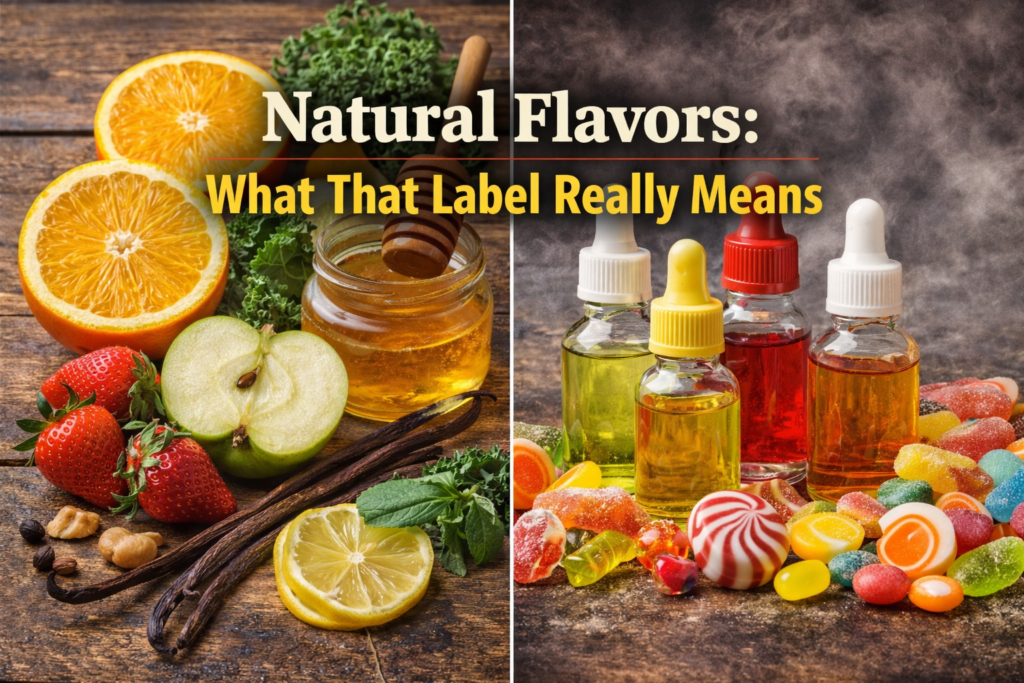
One of the most surprising realities for many people is that natural and artificial flavors can be chemically identical.
The difference often lies in how the compound was obtained, not how it behaves.
A flavor molecule derived from a plant and one synthesized in a lab may interact with taste receptors—and the body—in exactly the same way.
That’s why “natural” doesn’t automatically mean healthier. It describes source, not impact.
The Processing Layer Most Labels Don’t Show
Flavor compounds don’t appear in foods on their own. They’re typically:
- Extracted
- Stabilized
- Combined with carriers
- Protected from heat, light, and oxidation
Some of these substances don’t need to be listed separately if they’re considered part of the flavoring system.
That doesn’t mean labels are lying.
It means they’re not telling the whole story—because they’re not required to.
For consumers trying to make informed choices, that gap matters.
Who Should Pay Closer Attention
For many people, foods containing natural flavors won’t cause noticeable problems. But certain groups may want to be more cautious or curious.
This includes people who:
- Have food allergies or sensitivities
- Avoid animal-derived ingredients
- Are reducing ultra-processed foods
- Are managing metabolic or digestive health
Because natural flavors can come from either plant or animal sources, the label alone doesn’t always provide enough information.
Does “Organic Natural Flavors” Change Anything?
Organic certification does tighten some rules.
Organic natural flavors are generally subject to:
- Restrictions on certain solvents
- Limits on extraction methods
- Verified sourcing standards
That improves oversight, but it still doesn’t guarantee full transparency about how flavors are formulated.
Organic changes how something can be made.
It doesn’t eliminate the category itself.
Clearing Up the Internet Myths
Some of the most viral discussions around natural flavors focus on rare or extreme examples. These stories persist because they’re shocking—not because they’re common.
In modern food manufacturing, such cases are highly uncommon and tightly regulated.
Focusing on edge cases distracts from the real issue:
Consumers are expected to trust vague terms without meaningful context.
How to Read Labels More Intelligently
Instead of asking whether an ingredient is “good” or “bad,” ask better questions:
- Is this a whole food or a highly engineered one?
- Does this product rely on flavor systems to be appealing?
- Would it still exist without shelf-life engineering?
A minimally processed yogurt with a short ingredient list is very different from a shelf-stable snack designed to mimic indulgence.
Same words.
Different intent.
The Pattern We’re Not Supposed to Talk About
At the same time that labels have become softer and more comforting, something else has been accelerating.
- Obesity rates continue to climb
- Type 2 diabetes is rising
- Heart disease remains a leading cause of death
- Cancer rates are increasing across multiple categories
And despite decades of dietary guidelines, reformulations, and “better-for-you” branding, the trend lines keep moving in the same direction.
The official explanations are always vague:
- People should “eat better”
- People should “move more”
- People should “make healthier choices”
But that framing quietly shifts responsibility away from the system that shapes those choices in the first place.
When Food Is Engineered, Not Nourishing
Modern ultra-processed foods aren’t designed primarily for nourishment. They’re designed for:
- Maximum palatability
- Long shelf life
- Repeat consumption
- Cost efficiency at scale
Flavor systems—including “natural flavors”—play a central role in this. They allow products to taste indulgent even when nutritional value has been stripped away or heavily altered.
This isn’t accidental.
It’s profitable.
The more a product relies on engineered flavor instead of real ingredients, the cheaper it is to produce—and the longer it can sit on a shelf.
Meanwhile, the largest food corporations report billions of dollars in profit every year, even as diet-related disease continues to rise.
The system isn’t broken.
It’s optimized.
The Question No One Wants to Ask
If the same companies dominating the food supply are thriving financially while chronic disease rates continue to climb, it’s fair to ask:
- Are these outcomes really unrelated?
- Or are they the predictable result of a food environment built around processing, shelf stability, and engineered desirability?
This doesn’t require a conspiracy.
It only requires incentives.
When profit depends on volume, speed, and consumption, health becomes secondary unless it directly affects sales.
What Compliant Defiant Is Willing to Say Out Loud
We don’t claim there’s a single cause behind obesity, diabetes, heart disease, or cancer. Biology is complex. Lifestyle matters. Genetics matter.
But pretending that ultra-processed foods, engineered flavor systems, and opaque labeling practices play no role is no longer intellectually honest.
One of the root contributors to modern health epidemics isn’t personal failure—it’s a system that rewards convenience over nutrition and profit over transparency.
And the more familiar and comforting the language on the package sounds, the less likely people are to question what they’re actually consuming.
The Compliant Defiant Close
Compliance asks us to accept rising disease rates as normal.
Defiance asks why they’ve become profitable.
Compliant Defiant exists to question the systems that quietly normalize harm, to expose the incentives behind our food supply, and to replace comforting labels with uncomfortable clarity.
If we’re going to reverse these trends, the first step isn’t shame or restriction.
It’s understanding who benefits from the way we eat—and who pays the price.